What is an AI livestream host?
A plain definition of the AI livestream host, the four parts one is built from, the three things people mistake it for, and what it does badly.
"AI livestream host" now describes at least four different products, from a looping pre-recorded video with a caption bar to a system that reads your live chat and answers from your stock file. If you are evaluating one, the useful starting point is a definition narrow enough that you can check a vendor against it.
The short definition
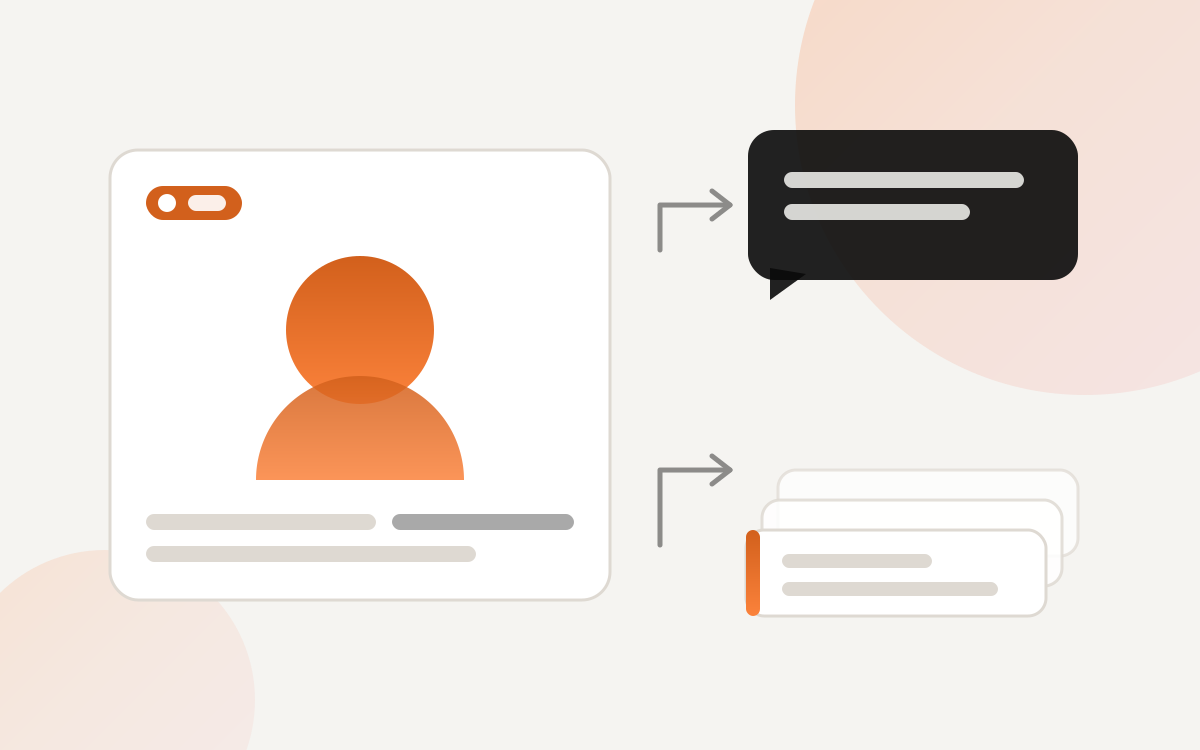
An AI livestream host is a synthetic presenter that runs a live shopping broadcast on its own. It appears on camera as an avatar, speaks with a synthetic voice, reads the platform's live chat as it arrives, and answers questions about your products from the catalogue you loaded, in the language each question was asked in.
The load-bearing word is live. A host that cannot see the chat is a video. A host that can see the chat but answers out of a language model's general knowledge is guessing about your inventory. The category is defined by one loop: comment in, grounded answer out, while the viewer is still watching.
Three things it is not
It is not a pre-recorded loop. Plenty of "24/7 AI streams" are a rendered video playing on repeat with a comment bot underneath. That is a legitimate format, and it is not this one. The test is simple: ask something in the chat that is only answerable from the seller's stock file, and see whether the person on screen says it out loud.
It is not a chatbot in the comment column. A bot that types replies is answering one viewer. A host that speaks the answer is answering everyone watching, which is where most of the value sits, because the same question is usually being wondered by a hundred silent viewers.
It is not a deepfake. Cloning a face or a voice requires consent from the person it belongs to, in writing, before the recording session. A product that will clone a public figure for you on request is a liability, not a feature. If you would rather not clone anyone at all, stock avatars and 600+ localized voices need no paperwork.
The four parts, and what breaks when one is weak
| Part | What it does | The failure mode |
|---|---|---|
| Avatar | Puts a presenter on camera and moves their mouth in time with the words | Lips out of sync with the audio, which viewers read as "fake" within seconds |
| Voice | Speaks the answer in the viewer's language | Flat prosody, wrong accent for the market, a pause before every sentence |
| Answering agent | Turns a comment into an answer built from your product records | Invents a size, a delivery date or a discount that does not exist |
| Stream plumbing | Holds the connection to each platform, ingests chat, keeps the session up | Drops out mid-session, or supports one destination at a time |
The four are usually sold as one product and are worth pricing as four. A system can have an excellent avatar and a rented voice API that adds a second of latency to every sentence, and the second thing is what the viewer notices.
For what the chain looks like end to end, we wrote it up in how a comment becomes a sale.
What it is genuinely good at
Hours nobody will staff. A human host has a schedule, so you can only buy the hours busy enough to justify one. Every hour either side of that goes unserved. This is the largest and least glamorous benefit, and it is mostly arithmetic rather than technology.
Languages you do not employ. A comment in Thai on a stream running in English gets a Thai answer in a Thai voice. Genpio answers chat in 85+ languages, which turns "should we open this market" from a hiring decision into a test you can run this week.
Saying the same true thing every time. The host answers from the catalogue, so the return policy is worded identically at 3pm and 3am. Human hosts paraphrase, and on the tenth hour of a shift they paraphrase loosely.
Being in several places at once. One catalogue can go out to 32 platforms simultaneously (TikTok, YouTube, Instagram, Shopee and Whatnot among them) rather than sequentially.
What it is not good at
This half of the list matters more, because it is the half vendors leave out.
- Taste and judgement. It will not notice that a product photographs badly under your lighting, or that a bundle makes no sense.
- Negotiation. It applies the rules you gave it. It does not read a hesitant buyer and invent an offer, which is exactly what you want on a channel running unattended, and exactly what you lose.
- Community. People follow people. A returning audience that shows up for a particular host is something a human builds and an avatar maintains.
- High-consideration purchases. The more a buyer needs to trust a specific person before spending, the less of the job an AI host does.
- Missing data. If shipping times are not in the catalogue, the host says it does not have that detail. Correct, and still a disappointing thing to watch.
- Your compliance. Platform rules on AI-generated presenters and on disclosure differ by platform and change over time. Reading the current version and disclosing where required is the seller's job. No tool takes that off your hands.
Five questions that separate the real ones
- How long between a comment and the spoken answer? Ask for a number, and ask what it is measured under. Sub-second is achievable; four seconds is a different product.
- Where does the answer come from? If the demo cannot show the product record that produced a specific sentence, it is not grounded.
- What happens when the catalogue does not have the answer? "Says it does not know" is the right answer. Anything else is a refund waiting to happen.
- Who owns the models? A stack assembled from three rented APIs has three rate limits, three outage pages and three price lists. Genpio trained and serves both the voice and the avatar models in house, which is a latency and cost decision before it is a bragging point.
- How is it priced? Pricing by the stream hour tracks the thing you actually consume, which is stream hours. Seat-based pricing for a product with no seats should prompt a question.
Where to start
If you want to see the answer loop rather than read about it, the shortest route is a demo on your own catalogue. There is no trial, free or paid, so this is how you see it before you buy. Load real products, then go into your own chat and ask the questions your customers actually ask, including two you know the catalogue cannot answer.
The pre-flight checklist covers what to have ready before that hour starts.