Selling live in a language you do not speak
What it takes to answer live chat in a language nobody on your team reads, and the review work that still needs a person.
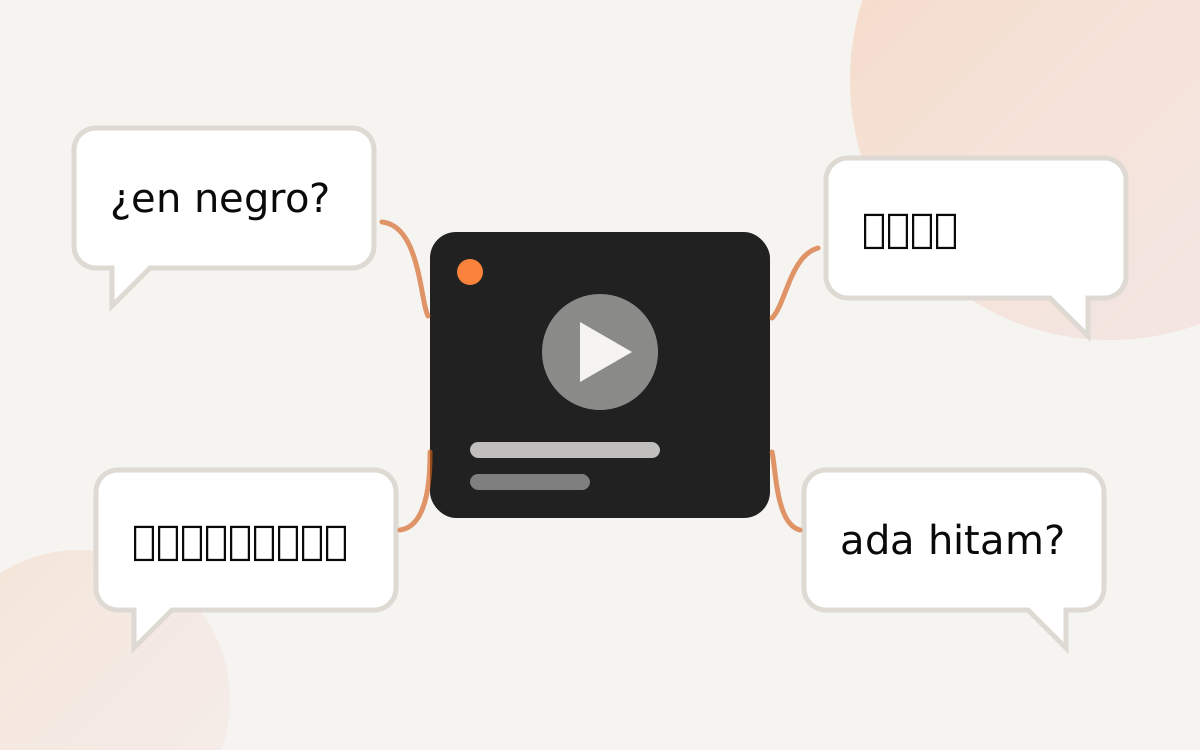
Look at the chat on any cross-border live stream and you will find questions nobody on the team can read. They are usually the same three questions - colour, size, shipping - asked in four languages, and the ones in the language you do not staff go unanswered until the viewer leaves.
That is the cheapest unclaimed demand in live commerce, and it is unclaimed for a boring reason: answering it used to mean hiring a second host, booking a second slot and streaming the same catalogue twice.
What "answers in their language" has to mean to be worth anything
The phrase is on every vendor's page. Three things decide whether it means anything on air.
Per comment, not per stream. A language setting on the session gets you a stream in one language. What the chat needs is a language tag on each comment, so a Thai question in an English-hosted stream gets a Thai answer while the English ones keep flowing. Genpio replies in 85+ output languages and picks per comment.
In one voice, without a seam. Live answers mix languages inside a single sentence, because your product names and sizes stay in their original form. A voice stitched together from several single-language models changes accent halfway through that sentence, and viewers hear it. Genpio Voices was trained in-house with more than 85 languages in the mix, trained together in a single run, and 60 of them carry baseline fluency straight out of it - which is why a sentence carrying a local question and an English product name comes out in one voice.
Fast enough to still be an answer. A reply that arrives ninety seconds later reaches someone who has already scrolled. The chain from comment to spoken reply is the subject of how a comment becomes a sale; the number that matters is under a second, end to end.
If a vendor's multilingual claim is really a translation layer bolted on after the voice, all three of those fail at once.
The four things that break when you staff this with people
Every multi-language live programme built out of headcount hits the same four walls, in this order.
- The schedule multiplies before the revenue does. Two languages is not two hosts, it is two hosts times the hours you want covered times the platforms you sell on. The rota is the thing that collapses, and it collapses at the point where each additional language is a fixed monthly cost against a share of demand nobody has measured yet.
- The second language gets the worst slot. Whoever books the room gives the proven language the good hours. So the new market is tested at a time its buyers are asleep, performs badly, and gets cut - having never been tested at all.
- Quality splits. Your best host knows the catalogue. The second-language host knows the language. The answers diverge, and the market that gets the thinner answers is the one you were trying to open.
- One person leaving closes a market. A language carried by a single contractor is a market with a single point of failure, and the notice period is when you find out.
An AI host does not make a language work. What it does is make the test cheap enough to run at the right hour, which is the only way to find out whether that language had demand behind it.
What still needs a human who reads the language
This is the half that gets left out, and skipping it is how a cheap experiment becomes an expensive apology.
- Script and product copy review. A native reader should see the script and the product records before the first stream. Machine-fluent copy can be grammatically perfect and commercially wrong - the wrong register for the category, or a claim that reads as a guarantee in that market.
- Moderation and the awkward cases. Complaints, price disputes and anything that reads as a legal or medical claim need a person. Decide in advance who reads the transcript and how fast.
- Local rules, read locally. Platform policy on AI-generated hosts is not uniform, and it is published in each market's own terms. Shopee allows AI livestreaming for approved sellers only, with content rules including a label on the stream. TikTok Shop's published ban on AI-generated voices in promotional LIVE states its own scope as the United States. Read your own seller centre terms rather than a vendor's summary of them, including ours.
- Reading back what was said. Every session leaves a transcript. In a language you do not read, that transcript is the only audit you have, so budget an hour a week of somebody who does.
The honest framing: the host can speak a language you do not. It cannot take responsibility for what was said in it. That stays with you.
A test that answers the question in one session
Put your real catalogue in and run one stream in the slot where your second-language buyers are actually awake - not your peak hour. Then, in the chat, do three things.
Ask a question in that language that can only be answered from your product data, such as which variant is still in stock. Ask one whose answer is not in your data at all: the right reply is that the information is not available, and anything more fluent than that is a refund on its way. And time the gap between your comment and the spoken answer.
Then have someone who reads the language check the transcript afterwards. That is the whole evaluation, and it costs one hour - the economics of which are in what an hour of livestream actually costs.
Where to start
Pick one language you can already see in your chat, one slot its buyers are awake for, and one honest reviewer. That is a smaller commitment than a hiring decision and it produces a number instead of an opinion.
There is no trial, free or paid. Book a demo at meet.genpio.com, bring the catalogue and the awkward questions, and see what comes back in which language.